

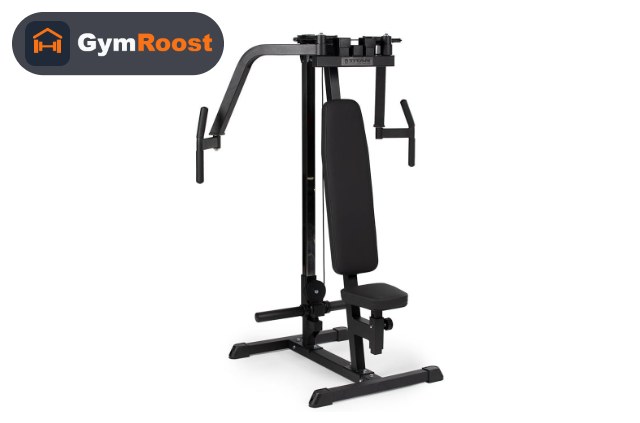
Plate-loaded chest fly machines give home lifters the feel of a commercial pec deck without the cost of a selectorized weight stack. You load Olympic or standard plates onto sleeves, and dual cams translate that weight into a smooth fly arc. Because you can keep adding plates, they scale well for strong lifters, and they are much lighter and cheaper to ship than stack machines.
The quality of a plate-loaded fly depends on sleeve capacity, cam design, frame thickness and how well the arm path fits your body. We compared machines on those factors along with footprint, versatility, rated capacity and buyer ratings, from sub-$200 budget models to Titan’s heavier-duty design.
Below are our top picks, a comparison table, detailed reviews and a buying guide. For our overall ranking, see the best chest fly machines, and for pressing machines that use the same plates, compare the best plate-loaded chest press machines.
Top 3 Plate-Loaded Chest Fly Machines

Titan Fitness Plate-Loaded PEC Fly and Reverse Delt Machine
- 10 in. loadable sleeves, up to 400 lb plates
- Dual overhead cams
- 300 lb user rating
- 32 x 28 x 65 in., 109 lb

SPART Adjustable PEC Fly and Reverse Delt Machine
- 50 x 50 mm, 14-gauge steel
- 600 lb rated (300 lb arms, 300 lb seat)
- Band pegs
- 61.9 x 38.7 x 65.3 in.

- Fly, reverse fly, rope crunch
- Handles rotate 57 to 303 degrees, 6 cam levels
- 4 seat heights, 575 lb machine load
- 48.6 x 38.6 x 65.8 in.
Plate-Loaded Chest Fly Machine Comparison
| Fly Machine | Best For | Key Specs | Amazon Rating | Price |
|---|---|---|---|---|
| 1. Titan Fitness Plate-Loaded PEC Fly and Reverse Delt Machine | Best Plate-Loaded | 10 in. loadable sleeves, up to 400 lb plates; Dual overhead cams; 300 lb user rating | 4.3/5 | Check Price |
| 2. SPART Adjustable PEC Fly and Reverse Delt Machine | Best Budget Plate-Loaded | 50 x 50 mm, 14-gauge steel; 600 lb rated (300 lb arms, 300 lb seat); Band pegs | 4.3/5 | Check Price |
| 3. HVO 3-in-1 Chest Fly Machine | Highest Total Load | Fly, reverse fly, rope crunch; Handles rotate 57 to 303 degrees, 6 cam levels; 4 seat heights, 575 lb machine load | 4.5/5 | Check Price |
| 4. Goimu CF01-PRO Chest Fly Machine | Best Arm Path | Pec fly + reverse delt, dual overhead cams; 6 positions on swiveling arms; Adjustable backrest, 400 lb rated | 4.5/5 | Check Price |
| 5. Mikolo Chest Fly Machine | Most Popular | Pec fly + reverse delt, dual overhead cams; 6 arm positions, band pegs; 400 lb rated | 4.2/5 | Check Price |
| 6. JFHID 3-in-1 Chest Fly Machine | Best Plate or Band | Fly + reverse delt + rows; Band hooks and 1 in./2 in. plate pegs; Under 9 sq ft footprint | 4.2/5 | Check Price |
1. Titan Fitness Plate-Loaded PEC Fly and Reverse Delt Machine – Best Plate-Loaded
- 10 in. loadable sleeves, up to 400 lb plates
- Dual overhead cams
- 300 lb user rating
- 32 x 28 x 65 in., 109 lb
Pros
- ✓ Small 32 x 28 in. base
- ✓ Heavier-duty Titan build
- ✓ Real plate loading
Cons
- ✗ $570
- ✗ 38 reviews
- ✗ Seat adjustments are pin-based
Titan’s plate-loaded pec fly and reverse delt machine is our top pick because it is built more like gym equipment than most home pec decks. The 10 inch loadable sleeves fit up to 400 lb of Olympic plates, and dual overhead cams with adjustable resistance let you move the arms independently or together, which is ideal for both bilateral flys and single-arm work.
Titan’s plate-loaded pec fly and reverse delt machine uses 10-inch loadable sleeves that fit up to 400 lb of Olympic plates. Dual overhead cams with adjustable resistance allow independent or simultaneous arm movement.
The footprint is just 32 by 28 inches and 65 inches tall, which is small for a pec deck, and the machine weighs about 109 lb. Titan’s build quality is a step above the budget brands.
It costs about $570 and has 38 reviews averaging 4.3 stars. Seat adjustments use pins.
Titan builds it for lifters who want a pec deck that feels like gym equipment rather than a home accessory. The cams are heavier and smoother, the steel is thicker, and the 10 inch sleeves hold enough plates for strong lifters. Its small base makes it easy to fit along a wall, though the arms still need room to swing.
Its compact 32 by 28 inch base and 65 inch height make it easy to fit along a wall, and the 109 lb frame stays steady during heavy sets. Titan’s thicker steel and smoother cams justify the higher price of about $570 for lifters who train chest and rear delts seriously. It holds a 4.3-star average from 38 buyers, and Titan’s parts support is better than most budget brands.
Best for: Serious lifters who want a durable plate-loaded pec deck
May not fit: Tight budgets
2. SPART Adjustable PEC Fly and Reverse Delt Machine – Best Budget Plate-Loaded
- 50 x 50 mm, 14-gauge steel
- 600 lb rated (300 lb arms, 300 lb seat)
- Band pegs
- 61.9 x 38.7 x 65.3 in.
Pros
- ✓ High rated capacity
- ✓ Under $250
- ✓ Stable 14-gauge frame
Cons
- ✗ 13 reviews
- ✗ Plates needed
- ✗ Bulky arm span
SPART’s pec fly is rated to 600 lb and costs under $250, with 14-gauge steel and band pegs.
SPART’s pec fly and reverse delt machine is built from 50 by 50 mm, 14-gauge steel. It is rated to 600 lb in total: 300 lb on the cables and 300 lb on the seat.
Band pegs add another resistance option. It measures about 62 by 39 inches and 65 inches tall and costs under $250.
It has only 13 reviews averaging 4.3 stars, and it needs plates.
For lifters on a budget who want a stable machine, the SPART is a strong value. The thicker steel and high rated capacity mean the frame stays steady during heavy sets, and the band pegs let you add accommodating resistance for a harder squeeze at the end of each rep. Expect a straightforward assembly and plan for plates.
For plate-loaded value, it offers the most capacity per dollar.
Best for: Heavy users on a budget
May not fit: Buyers who want many reviews
3. HVO 3-in-1 Chest Fly Machine – Highest Total Load
- Fly, reverse fly, rope crunch
- Handles rotate 57 to 303 degrees, 6 cam levels
- 4 seat heights, 575 lb machine load
- 48.6 x 38.6 x 65.8 in.
Pros
- ✓ Rope crunch adds core work
- ✓ Very adjustable arms
- ✓ Fits users up to 6 ft 2 in.
Cons
- ✗ Only 8 reviews
- ✗ Needs lubrication at first
- ✗ Plates needed
HVO’s 3-in-1 handles a 575 lb total machine load with 1 inch and 2 inch plates, plus rope crunches.
HVO’s 3-in-1 chest fly machine supports forward fly, reverse fly and seated rope crunches, adding core work to the usual upper-body menu. The jointed handles rotate between 57 and 303 degrees, and the top cam has six resistance levels.
Four seat heights fit users up to 6 ft 2 in., and the machine handles 1 inch and 2 inch plates with a total load of 575 lb. The footprint is about 49 by 39 inches and 66 inches tall.
It has only eight reviews, and HVO suggests lubricating the bearings and cable after assembly.
The extra rope crunch function makes it a good fit for small home gyms that want to cover chest, rear delts and abs with one purchase. The wide handle rotation helps lifters with long or short arms find a comfortable path, and the four seat heights cover most adults. Lubricate the cable and bearings after assembly for the smoothest motion.
Its six cam levels let you adjust the resistance curve as well as the plate load.
Best for: Versatile plate-loaded training
May not fit: Buyers who want proven reliability
4. Goimu CF01-PRO Chest Fly Machine – Best Arm Path

- Pec fly + reverse delt, dual overhead cams
- 6 positions on swiveling arms
- Adjustable backrest, 400 lb rated
- 44.9 x 53.5 x 65.2 in., 78 lb
Pros
- ✓ Freestyle arm path feels natural
- ✓ Single-arm rows possible
- ✓ Good price for the build
Cons
- ✗ Plates needed
- ✗ 35 reviews
- ✗ Arms need wall clearance
Goimu’s CF01-PRO pairs plate loading with the most natural freestyle arm path in this guide.
Goimu’s CF01-PRO is a plate-loaded chest fly and reverse delt machine with dual overhead resistance cams. Its freestyle arm design follows a natural movement path, which makes the squeeze at the end of a fly feel closer to a commercial pec deck.
The swiveling arms have six positions to fit different arm lengths and switch between pec fly and rear delt work. The cams support independent single-arm rows, and the adjustable backrest helps you line up the shoulder joint with the pivot. The machine is rated to 400 lb and measures about 45 by 54 inches and 65 inches tall.
It needs plates and some wall clearance for the arms. It holds a 4.5-star average from about 35 reviews and costs about $250.
In use, the freestyle arms are the reason it stands out. Rather than locking you into a rigid arc, they let your hands follow a slightly curved path that matches how your shoulders naturally move, which feels smoother at the stretch and lets you squeeze harder at the end. Load plates on the sleeves, set the arm position so your hands start just behind your chest, and use slow, controlled reps for the best results.
It is the best plate-loaded option for lifters who prioritize feel.
Best for: Feel-focused buyers
May not fit: Heavy plate stacks
5. Mikolo Chest Fly Machine – Most Popular

- Pec fly + reverse delt, dual overhead cams
- 6 arm positions, band pegs
- 400 lb rated
- 46 x 64.4 x 68.5 in.
Pros
- ✓ Most-reviewed budget pec deck (70+)
- ✓ Band pegs add accommodating resistance
- ✓ Unilateral or bilateral
Cons
- ✗ 4.2-star average
- ✗ 64 in. wide with arms open
- ✗ Plates needed
Mikolo’s machine is the most reviewed plate-loaded pec deck in this price range and includes band pegs.
Mikolo’s chest fly machine uses dual overhead resistance cams for independent or combined arm movement. Six positions on the swiveling arms let you switch between pec fly and reverse delt work.
Band pegs let you add accommodating resistance on top of plates, and the machine is rated to 400 lb. It measures about 46 by 64 inches and 68.5 inches tall. With about 73 reviews, it is the most reviewed budget pec deck on Amazon.
It holds a 4.2-star average, and the arm span is wide when open. It needs plates.
For most buyers, it is the safe choice in the budget pec deck category because so many people have used it and reported back. Common feedback praises the solid cam action and easy switch between fly and reverse fly, while the main complaints involve the width with arms open and occasional assembly confusion. Leave enough side clearance and follow the assembly video, and it delivers dependable chest and rear delt work for years.
Combining plates with bands gives a harder peak contraction.
Best for: Proven budget choice
May not fit: Narrow rooms
6. JFHID 3-in-1 Chest Fly Machine – Best Plate or Band

- Fly + reverse delt + rows
- Band hooks and 1 in./2 in. plate pegs
- Under 9 sq ft footprint
- 46 x 26.8 x 64.4 in., 75 lb
Pros
- ✓ Narrowest frame here (26.8 in.)
- ✓ Bands or plates
- ✓ Under $200
Cons
- ✗ 4.2-star average
- ✗ Light 75 lb frame
- ✗ Simple seat pad
JFHID’s machine accepts plates or bands on a narrow 26.8 inch frame for under $200.
JFHID’s 3-in-1 machine covers chest fly, reverse delt fly and rows with independent rotating arms. Ergonomic handles reduce wrist pressure.
It accepts resistance bands or 1 inch and 2 inch plates, and its footprint is under 9 square feet, just 26.8 inches wide. It weighs about 75 lb and costs under $200.
It holds a 4.2-star average from 39 reviews, and the frame is light.
It is a practical first pec deck for small rooms and beginners. Start with bands to learn the movement, then add plates as you get stronger. The light frame means it is easy to move, but keep loads moderate and use slow, controlled reps for the best feel and stability.
It is ideal if you want to start with bands and add plates later.
Best for: Small rooms
May not fit: Heavy plate loads
How to Choose a Chest Fly Machine
Pivot alignment and arm adjustment
A good pec deck lines up your shoulder joint with the machine pivot. Look for adjustable seat heights and multiple arm positions so the movement fits your arm length. Poor alignment shifts stress to the front of the shoulder. Machines with six or more arm positions and four or more seat heights fit the widest range of users. If you are taller than 6 ft 2 in. or shorter than 5 ft 4 in., check the listed height range before ordering. Take a moment to set the seat before each session: when the handles sit at mid-chest height and the pivot lines up with your shoulder, the squeeze lands squarely on the pecs rather than the front delts.
Plate-loaded, bands or stack
Most home pec decks are plate-loaded, which keeps the price down and lets you go heavy with your own plates. Band pegs add accommodating resistance that increases as you squeeze. Selectorized stack versions exist but cost far more. If you already own plates, a plate-loaded machine is the best value. If you do not, budget for 1 inch or 2 inch plates depending on the sleeve size. Bands and plates can also be combined for a harder lockout without overloading the stretched position.
Fly and rear delt in one
Most modern machines switch between pec fly and reverse delt fly by flipping the handles or changing arm position. This gives you chest and rear shoulder work from one frame, which balances posture. Some add rows or rope crunches. Make sure the switch is quick, because you will use both functions every week. Rear delt flys are one of the most effective exercises for posture, and doing them on the same machine as chest flys makes balanced training easy.
Footprint and arm swing
Pec decks look compact until the arms open. Check the width with arms extended, not just the base. Leave space behind for reverse flys. Machines with narrower bases still need wall clearance for the arms. Measure your space carefully if you are working in a corner or along a wall. Many buyers underestimate the arm swing, so mark the full range on the floor with tape before ordering.
Build and capacity
Look for 14-gauge or thicker steel, a rated capacity of at least 400 lb, and stable feet. Lighter frames may wobble during heavy flys. A heavier machine is more stable but harder to move. Check whether the capacity covers both your body weight and the plates you plan to load. Look at the seat and pad quality too, since dense foam and stitched vinyl hold up far better over years of use.
Independent arms
Dual overhead cams let each arm move independently, which helps fix strength imbalances between sides and allows single-arm flys and rows. Linked arms are simpler and slightly cheaper but less flexible. Independent arms also let you train around a minor shoulder issue by working one side at a time. Nearly every machine in this guide uses independent arms, but check the listing if unilateral work matters to you. It is one of the features that separates a real pec deck from a basic fly attachment on a bench.
Assembly and maintenance
Plan an hour or two of assembly with a second person to hold the arms in place. Lubricate bearings, pivots and any cables right after setup and every few months after that, since several makers note that a dry machine feels rough. Check and tighten bolts after the first week of use. Wipe the upholstery after sessions to keep the vinyl from cracking. A smooth, quiet motion is essential for the slow, controlled squeeze that makes fly training effective, so a little maintenance pays off.
FAQ
What is the best plate-loaded chest fly machine?
Titan’s plate-loaded pec fly is our top pick for its 10 inch sleeves, heavy-duty build and compact base. SPART offers the best capacity on a budget, and HVO handles the highest total machine load.
Is a plate-loaded fly machine better than a stack machine?
Plate-loaded machines cost much less, ship lighter and can go heavier if you own plates. Stack machines change weight faster. For most home gyms, plate-loaded pec decks offer better value.
How much plate weight do I need for chest flys?
Fly machines use leverage, so moderate plate loads feel heavy. Most lifters use 25 to 90 lb per side. Start with a few 10, 25 and 45 lb plates.
Do plate-loaded fly machines fit Olympic plates?
Most fit 2 inch Olympic plates, and many include adapters or detachable sleeves for 1 inch standard plates. Check the sleeve diameter on the listing.
How long are the sleeves on plate-loaded pec decks?
Sleeve length varies. Titan’s 10 inch sleeves fit several plates, while budget machines may have shorter pegs. Longer sleeves matter if you plan to load heavy.
How do I keep a plate-loaded fly machine stable?
Place it on a rubber mat, load both sides evenly and tighten bolts after the first week. Heavier frames like Titan’s are naturally more stable.
Final Verdict
Titan’s plate-loaded pec fly is our top pick because it combines heavy-duty construction, long sleeves and a compact base. SPART is the best budget option, and HVO offers the highest total load with extra versatility.
Goimu’s CF01-PRO has the best feel, Mikolo is the most proven budget machine and JFHID is best for small rooms. Store your plates neatly with one of the best racks for small home gyms.
No reviews yet. Be the first to share your experience!