

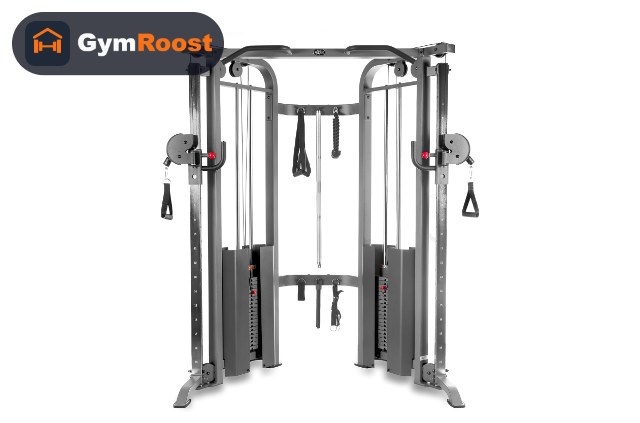
A cable machine is one of the most versatile pieces of equipment you can own. The constant tension of a cable trains muscles through the full range of motion, and changing a pulley height or attachment turns the same machine into a lat pulldown, a row, a chest fly, a triceps pushdown, a cable squat or a woodchopper. For home gyms, it often fills the gaps that dumbbells and a rack leave behind.
Cable machines come in very different formats, though: wall-mounted towers that take up three square feet, freestanding crossovers, and dual-stack functional trainers that rival commercial gyms. We compared resistance type, stack weight, pulley ratio, adjustment range, footprint, included attachments and buyer ratings across every format and price range.
Below are our top picks, a comparison table, detailed reviews and a buying guide. If you are shopping on a budget, see the best cable machines under $500, and stock up on the right handles with our guide to the best cable attachments for triceps.
Top 3 Cable Machines

XMARK XM-7626 Dual Stack Functional Trainer
- Dual 200 lb stacks (400 lb), 2:1 ratio
- 19 pulley heights, 12 to 75 in.
- 81 in. cable travel, built-in pull-up bar
- 43.5 x 65 x 83 in.

Body-Solid Powerline PFT100 Functional Trainer
- Two 160 lb stacks, 2:1 ratio
- Dual independent pulleys, pull-up bar
- Wide mainframe for bench work
- 42.3 x 62.6 x 83 in.

Goimu WM2-V4 Wall Mount Cable Station
- 155 lb selectorized stack + plate pin
- 33 positions, aluminum pulleys
- 2:1 adapter converts to 1:1
- 33 x 23.8 x 79 in.
Cable Machine Comparison
| Cable Machine | Best For | Key Specs | Amazon Rating | Price |
|---|---|---|---|---|
| 1. XMARK XM-7626 Dual Stack Functional Trainer | Best Cable Machine | Dual 200 lb stacks (400 lb), 2:1 ratio; 19 pulley heights, 12 to 75 in.; 81 in. cable travel, built-in pull-up bar | 4.8/5 | Check Price |
| 2. Body-Solid Powerline PFT100 Functional Trainer | Best Under $2,000 | Two 160 lb stacks, 2:1 ratio; Dual independent pulleys, pull-up bar; Wide mainframe for bench work | 4.6/5 | Check Price |
| 3. Goimu WM2-V4 Wall Mount Cable Station | Best Compact Stack | 155 lb selectorized stack + plate pin; 33 positions, aluminum pulleys; 2:1 adapter converts to 1:1 | 4.4/5 | Check Price |
| 4. Mikolo Wall Mount Cable Station | Best Plate-Loaded Tower | Plate-loaded dual pulley, 19/27 positions; Footboard for rows, 1 in./2 in. sleeves; Lat bar, handles included | 4.5/5 | Check Price |
| 5. Goimu WM1 Wall Mount Cable Station | Best Budget | 17 positions, high/low pulleys; 1:1 and 2:1 pulley options; Removable footplate | 4.5/5 | Check Price |
| 6. Mikolo Wall Mount Cable Station with 118 lb Stack | Best Wall Stack | 118 lb selectorized stack; Dual pulleys, 19/27 positions; 2:1 adapter for 1:1 pulls | 4.8/5 | Check Price |
1. XMARK XM-7626 Dual Stack Functional Trainer – Best Cable Machine
- Dual 200 lb stacks (400 lb), 2:1 ratio
- 19 pulley heights, 12 to 75 in.
- 81 in. cable travel, built-in pull-up bar
- 43.5 x 65 x 83 in.
Pros
- ✓ 4.8 stars from 640+ buyers
- ✓ Full attachment kit included
- ✓ Fits a corner, 84 in. ceilings
Cons
- ✗ $2,700+ price
- ✗ Delivery and build are a two-person job
- ✗ 2:1 ratio halves felt load
XMARK’s XM-7626 is our top cable machine because it combines commercial-level capability with the strongest buyer record in the category: a 4.8-star average from more than 640 buyers. Two independent 200 lb stacks on a 2:1 ratio let you train both sides together or one at a time, and a single pin changes the load in seconds, which makes supersets and drop sets effortless.
The XMARK XM-7626 is a full commercial-style functional trainer with two independent 200 lb weight stacks, 400 lb in total, on a 2:1 pulley ratio. A single pin changes the load, and each side works on its own, so you can train one arm or one leg at a time.
Pulleys adjust across 19 heights from 12 to 75 inches, swivel freely, and give you 81 inches of cable travel. The built-in pull-up bar has angled and straight grips, and the 60-inch spacing between handles leaves room for a bench. A full attachment kit ships in the box: triceps rope, long and short bars, hand straps, long strap handles, ankle straps and a leg strap.
At 84 inches tall, it fits most basements and garages, and the tapered frame tucks into a corner. It costs more than $2,700 and needs two people to build. The 4.8-star average from more than 640 buyers is the strongest record of any dual-stack trainer on Amazon.
The pulleys adjust across 19 heights from 12 to 75 inches and swivel freely, and 81 inches of cable travel keeps tension smooth through long movements such as high-to-low flys. A built-in pull-up bar adds bodyweight back work, and a complete attachment kit means you can train every muscle group on day one. At about $2,700 it is an investment, but it is the cable machine we would buy to last a decade or more.
Best for: Lifters who want the best all-round cable machine
May not fit: Tight budgets and low ceilings
2. Body-Solid Powerline PFT100 Functional Trainer – Best Under $2,000
- Two 160 lb stacks, 2:1 ratio
- Dual independent pulleys, pull-up bar
- Wide mainframe for bench work
- 42.3 x 62.6 x 83 in.
Pros
- ✓ Body-Solid warranty and parts
- ✓ 4.6 stars from 200+ buyers
- ✓ Compact for a dual-stack unit
Cons
- ✗ 160 lb stacks feel like 80 lb per hand
- ✗ Under-$2,000 but not cheap
- ✗ Heavy freight
Body-Solid’s PFT100 brings two 160 lb stacks and Body-Solid build quality for about $1,600, with a 4.6-star average from more than 200 buyers.
Body-Solid’s Powerline PFT100 is a functional training center with two 160 lb weight stacks on a 2:1 ratio. The dual independent pulleys allow true isolateral work, from crossovers and shoulder presses to kickbacks and single-arm rows.
The extra-wide mainframe gives room for bench work between the towers, and a pull-up bar sits on top. Body-Solid’s long warranty history and wide parts network are a real advantage over newer brands. The footprint is about 42 by 63 inches and 83 inches tall.
A 2:1 ratio means each 160 lb stack feels like about 80 lb at the handle, which suits most cable work but limits very heavy pulls. With a 4.6-star average from more than 200 buyers, it is the most proven dual-stack option under $2,000.
It is the most proven dual-stack machine for buyers who cannot stretch to XMARK.
Best for: Dual-stack training at a lower price
May not fit: Very heavy cable pulls
3. Goimu WM2-V4 Wall Mount Cable Station – Best Compact Stack
- 155 lb selectorized stack + plate pin
- 33 positions, aluminum pulleys
- 2:1 adapter converts to 1:1
- 33 x 23.8 x 79 in.
Pros
- ✓ Stack plus plates
- ✓ Wall mount saves floor
- ✓ Ratio switch
Cons
- ✗ Needs solid wall studs
- ✗ Only 7 reviews
- ✗ Single tower
Goimu’s WM2-V4 mounts on a wall and combines a 155 lb stack with a plate pin and aluminum pulleys for about $470.
Goimu’s WM2-V4 is a wall-mounted cable tower with a 155 lb selectorized weight stack plus a plate-loading pin, so you can use the stack, plates, or both together. Aluminum pulleys and 33 positions cover most cable exercises.
A 2:1 cable adapter lets you switch from 2:1 for endurance and drop sets to 1:1 for heavier pulls. The unit measures about 33 by 24 inches and 79 inches tall.
It needs solid wall studs and has only seven reviews. For a stacked cable station that takes up very little floor space, it is one of the most flexible options.
In daily use, the combination of stack and plate pin is what makes it special. Warm-ups and isolation work run off the stack with quick pin changes, and when you want heavy rows or pulldowns you add plates on top. Mount it to two solid studs with lag bolts, check the anchors after the first week, and it will feel as steady as a freestanding tower.
It offers stack convenience in a tiny footprint, with a 2:1 adapter for heavier 1:1 pulls.
Best for: Small spaces that want a stack
May not fit: Renters who cannot drill
4. Mikolo Wall Mount Cable Station – Best Plate-Loaded Tower

- Plate-loaded dual pulley, 19/27 positions
- Footboard for rows, 1 in./2 in. sleeves
- Lat bar, handles included
- 25.6 x 26.9 x 82 in., 400 lb
Pros
- ✓ 4.5 stars from 160+ buyers
- ✓ Corner-friendly
- ✓ Low price
Cons
- ✗ Needs plates
- ✗ Wall anchoring required
- ✗ Plate changes slow supersets
Mikolo’s wall-mount station is one of the best-selling compact cable machines on Amazon, with a 4.5-star average from about 170 buyers.
Mikolo’s wall-mount cable station is one of the best-selling compact cable machines on Amazon, with a 4.5-star average from about 170 buyers. It uses dual pulleys with 19 or 27 positions and fits neatly into a corner.
A large footboard supports seated rows, 10-degree angled weight pegs keep plates from sliding, and detachable sleeves fit 1 inch and 2 inch plates. A lat bar, cable handles and other attachments come in the box. The tower is about 26 by 27 inches and 82 inches tall.
It needs plates and wall anchoring, and plate changes slow supersets. For around $260, it delivers most cable movements in the smallest space.
In a small garage or spare room, this tower usually ends up being the most-used piece of equipment after a set of dumbbells. Mount it into studs or masonry with the right anchors, keep a few plates on the angled pegs, and you can run an entire upper-body session of pulldowns, rows, flys, curls and pushdowns without moving more than a few steps.
It costs about $260 and covers almost every cable exercise if you own plates.
Best for: Budget cable training
May not fit: Fast supersets
5. Goimu WM1 Wall Mount Cable Station – Best Budget

- 17 positions, high/low pulleys
- 1:1 and 2:1 pulley options
- Removable footplate
- 3.12 sq ft; 28 x 24.8 x 78.7 in.
Pros
- ✓ Cheapest real cable tower here
- ✓ 4.5 stars from 150+ buyers
- ✓ Attachments included
Cons
- ✗ Plates required
- ✗ 300 lb load limit
- ✗ Wall install
Goimu’s WM1 takes up just 3.12 square feet and costs under $200, with switchable 1:1 and 2:1 ratios.
Goimu’s WM1 is a wall-mounted cable crossover that takes up just 3.12 square feet. It combines lat pulldown, seated row, crossover, curl and single-arm row functions, and all the attachments you need are included.
Its dual-pulley system can switch between 1:1 and 2:1 ratios, so you can train heavy or light with the same plates. A removable footplate supports rows. The tower is about 28 by 25 inches and 79 inches tall, rated to 300 lb.
It needs plates and wall installation. With a 4.5-star average from more than 150 buyers and a price under $200, it is the cheapest real cable tower worth buying.
For first-time buyers, the WM1 is the easiest way to discover how much cable work adds to a home gym. Start with lat pulldowns, rows, face pulls and pushdowns, then use the low pulley for curls and kickbacks. Use 2:1 mode for smooth isolation work and 1:1 when you want the full weight of your plates on heavier pulls.
It is the cheapest real cable tower we would recommend.
Best for: First cable machine
May not fit: Heavy stack users
6. Mikolo Wall Mount Cable Station with 118 lb Stack – Best Wall Stack
- 118 lb selectorized stack
- Dual pulleys, 19/27 positions
- 2:1 adapter for 1:1 pulls
- Wall-mounted
Pros
- ✓ Pin-select speed
- ✓ 4.8-star average
- ✓ Very small footprint
Cons
- ✗ 118 lb ceiling
- ✗ Wall install required
- ✗ 17 reviews
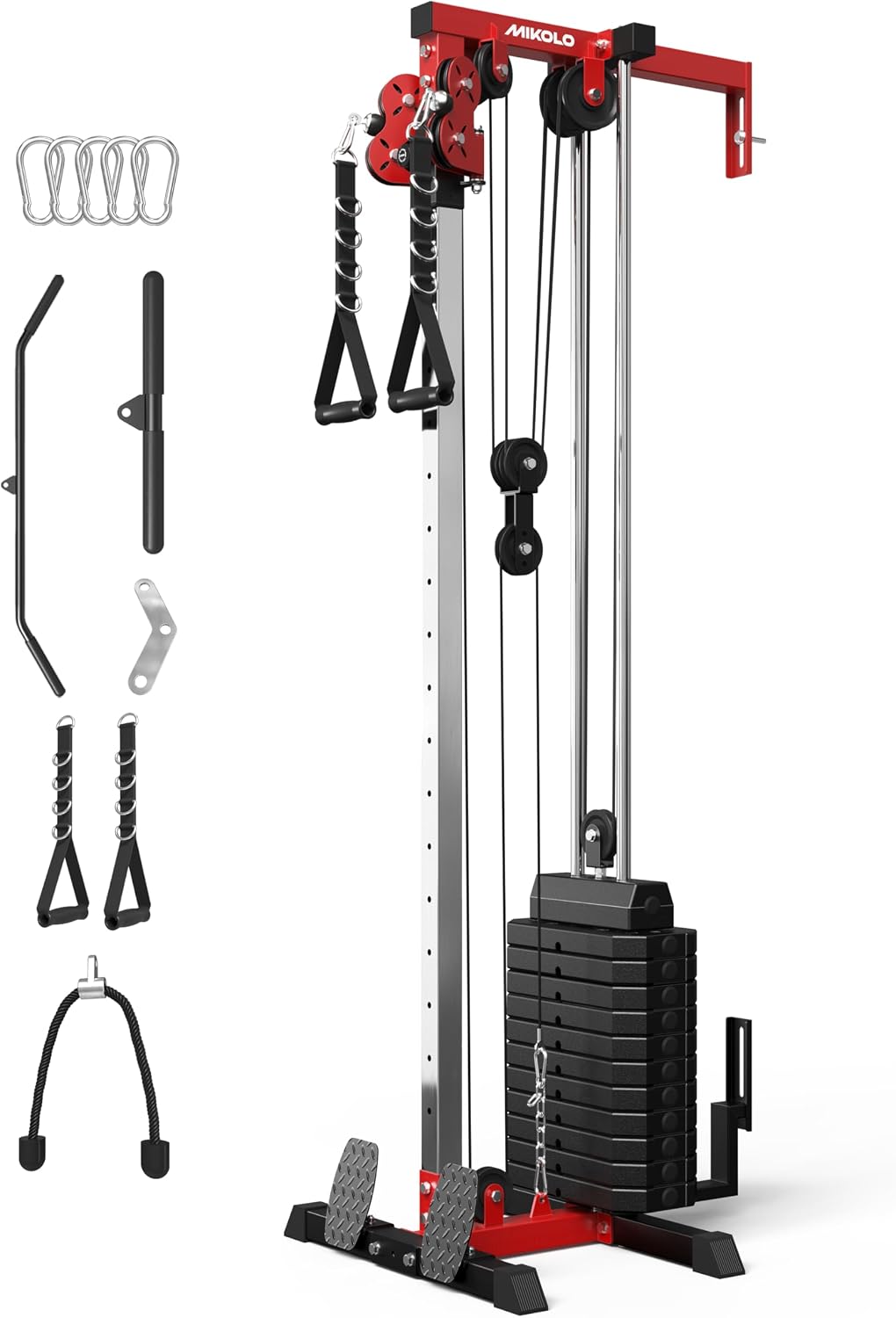
Mikolo’s stacked wall station adds a 118 lb selectorized stack to its compact design, with a 4.8-star average.
Mikolo’s stacked wall station adds a 118 lb selectorized weight system to its popular wall-mount design. Changing load is a pin drop, so drop sets and supersets are quick.
A 2:1 cable adapter connects both cables for a true 1:1 pull, so 118 lb feels like 118 lb on pulldowns and rows. The station offers 19 or 27 positions depending on version, and it takes up very little floor space.
The 118 lb ceiling will limit very strong lifters, and wall mounting is required. It holds a 4.8-star average from 17 buyers. For a compact stacked cable machine, it is one of the best.
It works best for lifters who value speed: you can move from pulldowns to pushdowns to curls in seconds, and drop sets take one pin pull. Mount it into solid studs, keep the included adapter handy for heavy pulls, and plan to add dumbbells or a rack for heavy lower-body work, since the stack is better suited to upper-body and accessory training.
A 2:1 adapter lets 118 lb feel like a true 118 lb on pulldowns.
Best for: Pin-select speed in small rooms
May not fit: Very strong lifters
How to Choose a Cable Machine for Home
Weight stack or plate-loaded
Weight stacks let you change resistance with a pin, which makes drop sets and supersets fast. Plate-loaded cable machines cost less and can go heavier with your own plates, but every change means loading plates. If you train with a partner or like fast sets, a stack is worth the extra cost. If you already own plates, a plate-loaded tower is a great value.
Pulley ratio
A 2:1 ratio halves the felt load and doubles cable travel, which suits flys, crossovers and lighter isolation work. A 1:1 ratio delivers the full weight and suits heavy pulldowns and rows. Some machines include an adapter to switch ratios. Check the ratio before comparing stack weights.
Single tower, wall mount or dual crossover
A single tower covers pulldowns, rows, curls and pushdowns. Wall-mounted dual pulleys add crossovers in a tiny footprint but need solid studs. Freestanding crossovers and functional trainers allow full flys and unilateral work but take the most space. Pick the format that fits your room and your exercise list.
Adjustment range
More pulley positions mean more exercise angles. Look for at least 15 positions and a range that reaches near the floor and above head height. Swivel pulleys follow your movement naturally. Laser-etched markings help you repeat settings.
Space and installation
Measure the ceiling first, because many towers stand 80 to 85 inches tall and you need a few inches above for assembly. Wall-mounted units need wood studs or proper masonry anchors, and renters should check before drilling. Freestanding crossovers and functional trainers need clearance on every side so handles do not hit walls when you step forward. Leave space for a bench between the towers if you plan to press or row from one, and plan for flooring under the frame to protect the floor and reduce noise.
Attachments
A good starter kit includes a lat bar, a straight bar, a triceps rope, two D-handles and an ankle strap. Many machines include most of these, while others charge extra, so compare complete packages. Quality attachments with rotating sleeves, knurled grips and solid carabiners make cable work feel far better. Add a multi-attachment belt if you want cable squats or hip thrusts, and a storage rack or hooks to keep everything off the floor. Budget around $50 to $120 if your machine ships with only the basics.
Smoothness and durability
Smoothness decides whether you enjoy using a cable machine. Aluminum pulleys with sealed bearings run quieter and smoother than plastic or bushing designs, and coated aircraft cables resist fraying. Check the cable rating and the warranty on pulleys and cables separately from the frame. Read reviews for comments about jerky movement or noise. A small amount of silicone lubricant on guide rods during break-in helps, and you should inspect cables every few months for fraying near the ends.
Budget tiers
Under $500 buys plate-loaded wall towers, freestanding lat towers and basic crossovers, which cover most cable exercises if you own plates. From $500 to $1,500 you get weight stacks, power cage combos with cables and better pulleys. Between $1,500 and $3,000 you reach dual-stack functional trainers and premium builds from brands such as XMARK, Body-Solid and REP. Set a budget that includes plates, attachments and flooring, then pick the best machine within it rather than stretching for features you will not use.
FAQ
What is the best cable machine for home use?
XMARK’s XM-7626 is our top pick for its dual 200 lb stacks, 19 pulley heights and outstanding buyer ratings. Body-Solid’s PFT100 is the best dual-stack option under $2,000, and Goimu’s WM2-V4 is the best compact machine with a weight stack. On a budget, Mikolo’s wall station and Goimu’s WM1 cover almost every cable exercise for under $300.
Is a cable machine worth it for a home gym?
Yes, if you want more exercise variety than dumbbells and a rack provide. Cable machines add lat pulldowns, rows, flys, pushdowns, face pulls and many isolation moves with constant tension. Even a compact wall tower can replace several pieces of equipment, making it one of the most space-efficient upgrades for a home gym.
What is the difference between a cable machine and a functional trainer?
A cable machine can be any pulley station, from a single lat tower to a wall-mounted dual pulley. A functional trainer specifically means two independent cable towers, usually with weight stacks, that allow crossovers and unilateral training. All functional trainers are cable machines, but not all cable machines are functional trainers.
Should I choose a weight stack or plate-loaded cable machine?
Weight stacks are faster and more convenient, especially for supersets and drop sets. Plate-loaded machines are cheaper and can go heavier if you own plates. If you train often and value speed, a stack is worth the extra cost; if budget is tight, plate-loaded towers are excellent value.
How much ceiling height does a cable machine need?
Most cable machines stand 77 to 85 inches tall. A standard 8 ft ceiling fits nearly all of them, but basements with 7 ft ceilings need shorter models such as GMWD’s 77 inch G7 Pro. Leave a few inches above for assembly and for any pull-up bar on top.
Final Verdict
XMARK’s XM-7626 is our top cable machine because it combines heavy dual stacks, wide adjustability and an exceptional buyer record. Body-Solid’s PFT100 is the best dual-stack value, and Goimu’s WM2-V4 brings a weight stack to small spaces.
For budget buyers, Mikolo’s wall station and Goimu’s WM1 deliver most cable exercises for under $300, while Mikolo’s stacked wall unit adds pin-select convenience. Pair any of them with the best lat pulldown attachments to get the most out of your cables.
No reviews yet. Be the first to share your experience!