

Starting strength training at home is easier when one machine guides you through the movements. An all-in-one home gym gives you a fixed path for presses, pulls and leg work, so you can focus on effort instead of balancing a barbell or worrying about dropping a dumbbell. For beginners, that guided motion is the difference between training consistently and giving up after a few awkward sessions.
Not every machine suits a new lifter, though. Some have confusing cable setups, some start too heavy, and some take up a room you do not have. We focused on machines with simple adjustments, low starting resistance, clear progression and strong safety features, and we leaned on real buyer ratings to see which ones people keep using after the first month.
Below are our top picks, a side-by-side comparison, detailed reviews and a buying guide written for first-time buyers. If you want to compare every option regardless of experience level, see our full list of the best all-in-one home gym machines, and if space is the main concern, read our guide to the best all-in-one home gyms for small spaces.
Top 3 All-in-One Home Gyms for Beginners

- Bodyweight incline resistance, 8 levels
- 70+ exercises incl. Pilates and HIIT
- 300 lb user capacity
- Folds for storage, 93 in. long

- 150 lb selectorized stack
- Press arms, lat bar, low row, leg developer
- Heavy-duty steel with guard rods
- 68 x 42 x 78 in.

Mikolo 150 lb Home Gym Workout Station
- 152 lb weight stack, 14-gauge steel
- Pec fly, lat pulldown, low row, chest press, leg press/extension
- 90+ exercises listed
- 75 x 36.3 x 80 in., 300 lb
Beginner All-in-One Home Gym Comparison
| Machine | Best For | Key Specs | Amazon Rating | Price |
|---|---|---|---|---|
| 1. Total Gym APEX G3 | Best for Beginners | Bodyweight incline resistance, 8 levels; 70+ exercises incl. Pilates and HIIT; 300 lb user capacity | 4.6/5 | Check Price |
| 2. Marcy MWM-990 150 lb Home Gym | Best Weight Stack for Beginners | 150 lb selectorized stack; Press arms, lat bar, low row, leg developer; Heavy-duty steel with guard rods | 4.4/5 | Check Price |
| 3. Mikolo 150 lb Home Gym Workout Station | Best With Leg Press | 152 lb weight stack, 14-gauge steel; Pec fly, lat pulldown, low row, chest press, leg press/extension; 90+ exercises listed | 4.5/5 | Check Price |
| 4. BowFlex PR1000 Home Gym | Best Lightweight Option | 200+ lb Power Rod resistance; 25+ exercises, multiple pulley positions; Bench converts to rolling rowing seat | 4.6/5 | Check Price |
| 5. Goplus 100 lb Multifunction Home Gym | Best Budget Stack Machine | 100 lb weight stack; Dual-function press arm, lat pulldown; Leg developer | 4.2/5 | Check Price |
| 6. FJÖR XT Trainer Compact Home Gym | Best Guided Workouts | Digital concentric resistance; 85+ workouts with app guidance; Compact frame, no weight plates | 4.2/5 | Check Price |
1. Total Gym APEX G3 – Best for Beginners
- Bodyweight incline resistance, 8 levels
- 70+ exercises incl. Pilates and HIIT
- 300 lb user capacity
- Folds for storage, 93 in. long
Pros
- ✓ 4.6 stars from 3,900+ buyers
- ✓ Folds and slides under a bed
- ✓ Very joint-friendly
Cons
- ✗ Resistance limited by your bodyweight
- ✗ Not for heavy strength goals
- ✗ Needs 8 ft of length to use
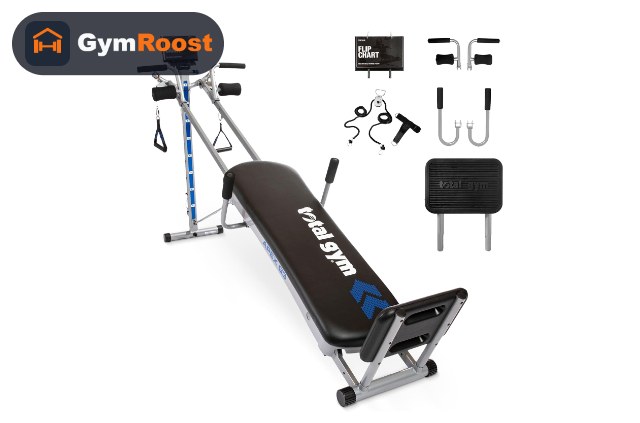
For a true beginner, the Total Gym APEX G3 is the gentlest way into strength training. There are no plates or pins to learn, the glideboard keeps every movement controlled, and you change difficulty simply by raising the incline. That makes it easy to start with very light work and add resistance in small steps as your strength and confidence grow.
Total Gym’s APEX G3 uses your bodyweight on an inclined glideboard instead of weights. Raise the glideboard and the resistance goes up across eight levels, so you can start very easy and progress without buying anything else. The cable pulley system and padded board make every movement smooth and controlled.
More than 70 exercises are possible, including strength moves, Pilates, stretching and HIIT. It supports users up to 300 lb and folds for storage, which is why it is a favorite with beginners, older lifters and anyone coming back from injury. Its 4.6-star average comes from almost 3,900 ratings.
The limit is load. Bodyweight resistance tops out well below what a weight stack offers, so it will not build maximal strength. You also need a clear lane about 93 inches long when it is open. For gentle, full-body training that stores away, it is one of the easiest machines to live with.
The APEX also builds habits that carry over. Squats, rows, presses, curls and core moves all use the same board and cables, so you learn one setup and use it for a full-body session in 20 to 30 minutes. Because it folds away, it does not take over a room, which removes one of the biggest reasons beginners stop training at home. When you outgrow it, the movement skills transfer directly to a stack machine or free weights.
Best for: New lifters, older users and anyone returning from injury
May not fit: Lifters who want heavy strength or muscle-building loads
2. Marcy MWM-990 150 lb Home Gym – Best Weight Stack for Beginners
- 150 lb selectorized stack
- Press arms, lat bar, low row, leg developer
- Heavy-duty steel with guard rods
- 68 x 42 x 78 in.
Pros
- ✓ 2,400+ ratings, long track record
- ✓ Covers chest, back, arms and legs
- ✓ Good value for a stack machine
Cons
- ✗ Leg developer feels light for big legs
- ✗ Takes 4 to 6 hours to assemble
- ✗ Cables need re-tensioning after break-in
If you want to train with real iron from day one, the Marcy MWM-990 is the simplest stack machine to learn. Every station uses the same pin-select system, so changing weight is one motion, and the 150 lb stack starts light enough for beginners while leaving room to progress for a year or more.
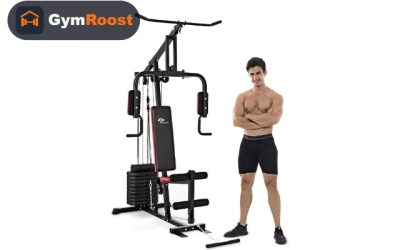
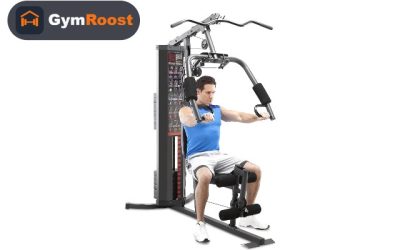
The MWM-990 is Marcy’s best-known stack machine, with more than 2,400 ratings and a 4.4-star average. It packs a 150 lb selectorized stack, press arms, a lat bar, a low row and a leg developer into a 68 by 42 inch footprint, and it remains one of the most popular first machines for people moving from a commercial gym to a spare room.
Day to day it is simple to run. You set the seat, pull the pin, and train. The press arms switch between chest press and pec fly, the curl pad lifts off when you need room for rows, and the high pulley handles lat pulldowns and triceps work. Heavy-duty steel with guard rods keeps the stack running straight, and the cables use pulleys that are easy to replace years down the line.
Expect four to six hours of assembly and a cable re-tension after the first few sessions. The leg developer will feel light if you already squat heavy, and there is no leg press sled. Those limits aside, the MWM-990 is the benchmark that every other budget station gets compared with, and it is easy to find parts and help for it.
Best for: Beginners who want a classic gym-style station
May not fit: Lifters who need a leg press or heavy back work
3. Mikolo 150 lb Home Gym Workout Station – Best With Leg Press
- 152 lb weight stack, 14-gauge steel
- Pec fly, lat pulldown, low row, chest press, leg press/extension
- 90+ exercises listed
- 75 x 36.3 x 80 in., 300 lb
Pros
- ✓ Leg press built in
- ✓ Steel shroud around the stack
- ✓ Wide exercise menu for the money
Cons
- ✗ Footprint is deeper than basic stations
- ✗ Leg press load limited by the stack
- ✗ Assembly is involved
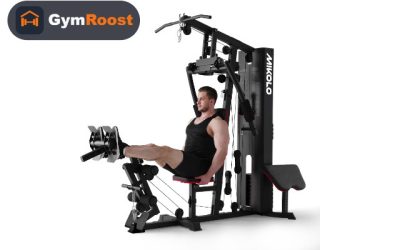
Mikolo’s station suits beginners who want legs covered properly from the start. The leg press and leg extension share the same 152 lb stack as the upper-body stations, so you learn one machine and train every major muscle group without buying anything else.
Mikolo’s workout station is built around a 152 lb weight stack inside a steel shroud, which keeps fingers and cables away from moving plates. The frame uses 14-gauge steel and weighs about 300 lb assembled, so it feels planted during heavy rows and leg presses. Mikolo lists more than 90 exercises across its stations.
The headline feature is that the leg press sits on the same machine as the pec fly, lat pulldown, low row, chest press, leg extension and preacher curl. That is a rare combination at around $600, and it means you can run a full push, pull and legs routine without adding a second machine. The footprint is roughly 75 inches deep, 36 inches wide and 80 inches tall.
Because every station shares the single stack, your leg press load is capped at the stack weight plus leverage, so it will not replace a plate-loaded leg press for strong legs. The extra depth also matters in tight rooms. For most home lifters who want everything on one frame and a 4.5-star average from almost 300 buyers, it is a strong value.
Best for: Beginners who want a complete push, pull and legs setup
May not fit: Very small rooms; the frame is 75 inches deep
4. BowFlex PR1000 Home Gym – Best Lightweight Option

- 200+ lb Power Rod resistance
- 25+ exercises, multiple pulley positions
- Bench converts to rolling rowing seat
- 84 x 38 x 82 in., 144 lb
Pros
- ✓ 4.6 stars from 2,700+ buyers
- ✓ Light enough for upper floors
- ✓ No subscription, no plates
Cons
- ✗ Rod resistance feels different from free weights
- ✗ Resistance tops out for strong lifters
- ✗ Long footprint
The BowFlex PR1000 is a smart first machine for beginners in apartments or upstairs rooms. At about 144 lb, it is far lighter than stack stations, rod resistance starts low, and there is no monthly fee or app to manage.
The BowFlex PR1000 is the lightest machine in this group at about 144 lb, which is why it shows up in upstairs bedrooms and apartments where a 300 lb stack station is a non-starter. Resistance comes from Power Rods rather than iron plates, giving you more than 200 lb of rated rod resistance through a pulley system with multiple positions.
You get more than 25 exercises, a vertical bench press with incline and flat settings, and a seat that converts to a rolling slide for aerobic rowing. It also has a device holder, but no subscription is needed to use it. Its 4.6-star average from more than 2,700 buyers is one of the strongest records in the category.
Rod resistance ramps up as the rods bend, so it feels different from a weight stack or dumbbells, and very strong lifters will find the ceiling. The machine is also long at about 84 inches. If you want a quiet, light, joint-friendly full-body machine with no plates and no monthly fee, the PR1000 is hard to beat.
Best for: Upstairs rooms and joint-friendly training
May not fit: Lifters who want free-weight feel
5. Goplus 100 lb Multifunction Home Gym – Best Budget Stack Machine

- 100 lb weight stack
- Dual-function press arm, lat pulldown
- Leg developer
- 50 x 39 x 82 in., 330 lb capacity
Pros
- ✓ One of the cheapest stack gyms
- ✓ Small 50 x 39 in. footprint
- ✓ Fine for beginners
Cons
- ✗ 100 lb stack outgrown quickly
- ✗ Lighter-gauge frame
- ✗ Pulleys less smooth
Goplus offers the lowest-cost route to a real weight stack. Its 100 lb stack is enough for a beginner’s first months of pressing, pulling and curling, and the small 50 by 39 inch footprint fits a spare bedroom.
Goplus offers one of the cheapest true stack machines on Amazon, with a 100 lb weight stack, a dual-function press arm, a lat pulldown and a leg developer. The frame is just 50 by 39 inches, which makes it one of the smallest station footprints here.
The dual-function arm handles both chest press and butterfly work, and the cable system covers pulldowns, pushdowns, curls and rows. The machine weighs about 180 lb assembled and is rated for 330 lb, enough for most beginner and intermediate users.
The 100 lb stack is the obvious limit; many users outgrow it on pulldowns within months. The frame uses lighter tubing than Marcy or Mikolo and the pulleys feel less refined. For a first machine in a small room on a tight budget, it is a reasonable starting point.
Best for: Tight budgets and small rooms
May not fit: Anyone already strong on pulldowns
6. FJÖR XT Trainer Compact Home Gym – Best Guided Workouts

- Digital concentric resistance
- 85+ workouts with app guidance
- Compact frame, no weight plates
- Real-time feedback
Pros
- ✓ Tiny footprint
- ✓ No plates to store
- ✓ Quiet for apartments
Cons
- ✗ Concentric-only feel
- ✗ Only 23 reviews
- ✗ Not for max-strength work
FJÖR’s XT Trainer is aimed at beginners who want coaching built in. Digital concentric resistance keeps the lowering phase light, which reduces soreness in the first weeks, and app-guided sessions tell you what to do each day.
The FJÖR XT Trainer is a compact, plate-free trainer that uses digital concentric resistance. It loads you on the lifting phase and lets the lowering phase stay light, which reduces soreness and makes it easy for beginners to learn movements.
The frame is slim enough to tuck into a corner of a living room, and the company lists more than 85 workouts with real-time feedback and app-guided sessions. It runs quietly, which matters in apartments with neighbors below.
Concentric-only resistance is not a full substitute for a weight stack, and the review base is still small at about 23 ratings. If you want minimal footprint and guided workouts, it works; if you want heavy, traditional lifting, choose a stack machine.
Best for: Beginners who want structure and minimal soreness
May not fit: Traditional heavy lifting
How to Choose an All-in-One Home Gym Machine
Resistance type: stack, plates, rods or motors
Weight stacks are the fastest to adjust: move a pin and lift. Plate-loaded cables and Smith bars cost less up front and scale higher, but every change means sliding plates on and off, which slows supersets. Power Rod machines such as BowFlex are light and quiet but feel different from iron because tension rises as the rods bend. Bodyweight incline trainers like Total Gym are gentle and fold away, while motor-driven smart gyms pack heavy resistance into a small box but depend on electricity and software. Match the resistance to how you like to train, not just to the price.
Stack weight and pulley ratio
A 150 lb stack sounds heavy until you hit it on lat pulldowns. Many lifters outgrow 100 to 150 lb stacks on back and leg work within a year. Check the pulley ratio too: a 2:1 ratio halves the felt load at the handle but gives smoother, longer cable travel, while 1:1 delivers the full weight. If you are already strong, look for a 160 lb or heavier stack, add-on weight options, or a hybrid design that lets you hang plates on the stack.
Footprint, ceiling height and doors
Measure three things before you buy: the floor area, the ceiling height and the narrowest door the boxes must pass through. Most stack stations stand 78 to 82 inches tall, while Smith and cage combos run 84 to 90 inches. Leave at least 2 ft of clearance around cable stations so handles and bars do not hit walls. Long machines such as rod gyms or incline trainers also need a clear lane in front. A machine that technically fits but leaves no room to move will end up unused.
Stations you will actually use
Write down the five or six movements you train every week, then check that the machine handles each one well. A chest press, lat pulldown, seated row and leg extension cover most needs. A leg press or Smith bar is a major upgrade for lower-body strength. Extras such as preacher pads, ab crunch straps or pec decks are nice but should not decide the purchase. A simpler machine that does your core lifts well beats a complicated one with 100 listed exercises you never try.
Build quality and user capacity
Look for steel tube gauge (lower numbers mean thicker steel), total machine weight and the rated user capacity. Heavier frames resist wobble, and a 300 lb user rating is the minimum to consider. Shrouded stacks protect fingers, and sealed-bearing pulleys run quieter and last longer. Check the warranty on frame, pulleys and cables separately. Brands with long track records, such as Marcy, BowFlex and Body-Solid, are easier to get parts for years later.
Assembly and delivery
Most all-in-one machines arrive in several boxes totaling 250 to 800 lb. Plan for two people and four to eight hours of assembly, longer for Smith combos. Cable routing is the step that trips most people up, so watch the manufacturer’s video first. Freight deliveries often stop at the curb, so check whether you need help moving boxes into a basement. Re-check bolts and cable tension after the first two weeks of use.
Subscriptions and long-term cost
Traditional stack, plate and rod machines have no monthly fees. Smart gyms often include free basic use but put classes or advanced modes behind a membership. Add plates, a bench, flooring and attachments to your budget, since many machines ship without them. A machine at $600 plus $300 of plates can cost more than a $900 package that includes them, so compare complete setups rather than base prices.
Flooring and noise
Stack machines and Smith bars transfer impact into the floor. Put down 3/4 inch rubber mats or interlocking tiles, especially on upper floors or over finished basements. Shock-absorbing feet and covered stacks reduce clanking, and rod or motor systems are quietest. If you train early or late in an apartment, noise can matter more than any spec on the box.
FAQ
What is the best all-in-one home gym for a beginner?
For most beginners, the Total Gym APEX G3 is the easiest place to start because it uses adjustable bodyweight resistance, folds away and has more than 70 guided exercises. If you prefer iron weights and a classic gym feel, the Marcy MWM-990 is the simplest stack machine to learn. Both offer low starting resistance and a clear way to progress, which matters more than the number of exercises listed.
Is an all-in-one machine better than free weights for beginners?
Machines guide the path of each movement, which reduces the balance and coordination demands that make free weights intimidating at first. That lets beginners focus on effort and consistency. Free weights build more stabilizer strength over time, so many people start on a machine and add dumbbells later. A machine is also safer when training alone because there is no bar to get stuck under.
How much weight does a beginner need on a home gym?
Most beginners do well with 100 to 150 lb of stack resistance for the first year, because many exercises such as curls, pushdowns and flys use light loads. Lat pulldowns and leg work are where you will hit the ceiling first. If you are already active or expect to progress quickly, a 150 lb or larger stack, or an upgradable rod system, will last longer.
How long does it take to assemble a home gym machine?
Plan two to six hours depending on the machine. Bodyweight trainers such as Total Gym arrive mostly assembled. Rod machines take an hour or two. Stack stations from Marcy or Mikolo usually take four to six hours, and cable routing is the trickiest step. Watch the manufacturer’s video first and have a second person help with heavy parts.
How often should beginners train on an all-in-one home gym?
Three full-body sessions a week, with a rest day between each, is a reliable starting plan. Choose one push, one pull, one leg and one core exercise per session, and do two to three sets of 10 to 15 reps. Add weight or incline when the last reps start to feel easy. Consistency over the first three months matters far more than any specific program.
Do beginner home gyms need a subscription?
No. Traditional machines like Total Gym, Marcy, Mikolo, BowFlex and Goplus work without any membership. Some smart trainers offer app guidance, and a few put advanced content behind a paid plan, but basic use is free on every machine in this guide.
Final Verdict
The Total Gym APEX G3 is our top pick for beginners because it removes almost every barrier to starting: there is nothing to load, resistance begins very low, and the machine folds away when you are done. The Marcy MWM-990 is the best choice if you want a traditional weight stack and a gym-style layout, and the Mikolo station is the most complete option if leg training matters to you from day one.
If space or noise is the issue, the BowFlex PR1000 is light and quiet, while the Goplus is the most affordable stack machine. Whichever you choose, add a mat underneath and a simple three-day plan, and pair the machine with a set of beginner-friendly adjustable dumbbells when you are ready for more variety.
No reviews yet. Be the first to share your experience!