

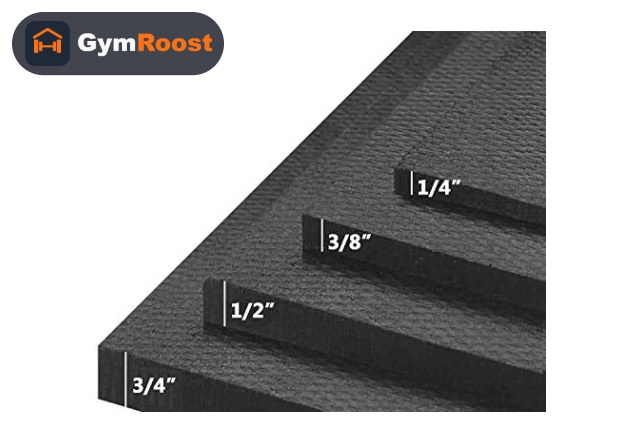
Bare concrete is hard on your equipment, your joints and your weights. Garage gym flooring protects the slab from dropped dumbbells and barbells, keeps equipment from sliding, reduces noise and makes the space more comfortable to train in.
The best flooring depends on how you train. Heavy barbell lifting calls for 3/4 inch rubber, cardio and dumbbell areas can use thinner rubber or rubber-top tiles, and very heavy drops need platform tiles on top. Odor, weight and ease of installation also matter in an attached garage.
We compared six garage gym flooring options on thickness, material, odor, installation and price. See also the best 3/4 inch horse stall mats for home gym and the best gym floor tiles for garage gyms.
Top 3 Garage Gym Flooring Picks

American Floor Mats Ultimate Gym Mat 4 x 7 ft
- 4 x 7 ft x 3/4 in.
- Lays flat
- Reduced odor process
- Also in 1/4 to 1/2 in.

DWC 4 x 6 ft x 3/4 in. Rubber Mat
- 4 x 6 ft x 3/4 in.
- About 115 lb per mat
- Recycled tire rubber
- Made in Canada

SUPERJARE 0.79 in. Extra-Thick Rubber Top Tiles
- 12 tiles, 24 x 24 x 0.79 in.
- EPDM rubber top, EVA base
- Detachable edge strips
- 48 sq ft
Garage Gym Flooring Comparison
| Flooring | Best For | Key Specs | Amazon Rating | Price |
|---|---|---|---|---|
| 1. American Floor Mats Ultimate Gym Mat 4 x 7 ft | Best Garage Gym Flooring | 4 x 7 ft x 3/4 in.; Lays flat; Reduced odor process | 4.6/5 | Check Price |
| 2. DWC 4 x 6 ft x 3/4 in. Rubber Mat | Best Value Rubber | 4 x 6 ft x 3/4 in.; About 115 lb per mat; Recycled tire rubber | 4.2/5 | Check Price |
| 3. SUPERJARE 0.79 in. Extra-Thick Rubber Top Tiles | Best Interlocking Tiles | 12 tiles, 24 x 24 x 0.79 in.; EPDM rubber top, EVA base; Detachable edge strips | 4.5/5 | Check Price |
| 4. BASELAYER Performance Series TPE Floor Tiles | Best Low-Odor Tiles | 12 tiles, 19 x 19 x 1/2 in.; Injection-molded TPE, not foam; Low odor | 4.7/5 | Check Price |
| 5. IncStores 1/4 in. Tough Rubber Roll | Best Rubber Roll | 1/4 in. recycled rubber roll; 3 or 4 ft wide; Made in the USA | 4.3/5 | Check Price |
| 6. American Floor Mats 3/8 in. Rubber Roll 4 x 8 ft | Best 3/8 Inch Roll | 4 x 8 ft x 3/8 in.; Solid black rubber; Lays flat | 4.7/5 | Check Price |
1. American Floor Mats Ultimate Gym Mat 4 x 7 ft – Best Garage Gym Flooring
- 4 x 7 ft x 3/4 in.
- Lays flat
- Reduced odor process
- Also in 1/4 to 1/2 in.
Pros
- ✓ Larger than stall mats
- ✓ Low odor
- ✓ Premium build
Cons
- ✗ About $264
- ✗ Very heavy
- ✗ Straight edges (not interlocking)
American Floor Mats’ Ultimate stand-alone gym mats are our top flooring for a garage gym because they take the proven stall-mat formula and fix its biggest weaknesses. Standard horse stall mats are dense and affordable, but they often smell strongly, can curl at the edges and vary in size. These 3/4 inch mats are made with a proprietary process that helps them lie flat in demanding environments and reduces the sharp chemical odor recycled rubber is known for.
At 4 x 7 ft, each mat covers 28 square feet, more than a typical 4 x 6 ft stall mat, so you need fewer pieces and get fewer seams in your lifting area. The 3/4 inch solid black rubber protects concrete from dropped dumbbells and racked barbells and stays stable under squat racks, benches and cardio machines. You can use a single mat as a lifting station or line several up wall to wall to cover a whole garage bay.
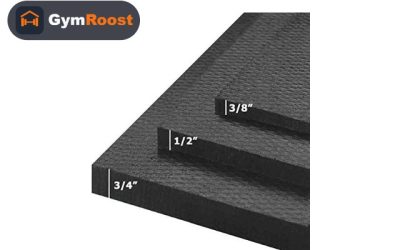
American Floor Mats also sells these mats in 1/4, 3/8 and 1/2 inch thicknesses, so you can use lighter mats under cardio equipment and 3/4 inch mats where you lift. More than 230 buyers give them a 4.6-star average.
The downsides are price and weight: at about $264 per mat, they cost more than standard stall mats, they are heavy to move and, unlike puzzle tiles, they don’t interlock, so edges simply butt together. For a clean, low-odor, flat garage gym floor, they’re worth it.
Best for: Garage gyms that want a clean, low-odor floor
May not fit: Tight budgets
2. DWC 4 x 6 ft x 3/4 in. Rubber Mat – Best Value Rubber
- 4 x 6 ft x 3/4 in.
- About 115 lb per mat
- Recycled tire rubber
- Made in Canada
Pros
- ✓ CrossFit-gym standard
- ✓ Can be cut with a utility knife
- ✓ Smooth top
Cons
- ✗ About $166
- ✗ Heavy to move
- ✗ Few ratings
DWC’s 4 x 6 ft x 3/4 inch rubber mat is the classic budget garage gym floor: dense recycled tire rubber, about 115 lb per mat and described by DWC as the industry standard for CrossFit gyms.
Its weight keeps it in place without adhesive, and it can be cut with a box cutter to fit around posts or steps. It is made in Canada.
It has fewer than 30 ratings, smells when new and is very heavy to move.
Best for: Budget heavy lifting
May not fit: Low-odor needs
3. SUPERJARE 0.79 in. Extra-Thick Rubber Top Tiles – Best Interlocking Tiles
- 12 tiles, 24 x 24 x 0.79 in.
- EPDM rubber top, EVA base
- Detachable edge strips
- 48 sq ft
Pros
- ✓ Extra cushioning
- ✓ Lower odor rubber
- ✓ 600+ ratings
Cons
- ✗ About $133
- ✗ Foam base under heavy drops
- ✗ Edge pieces
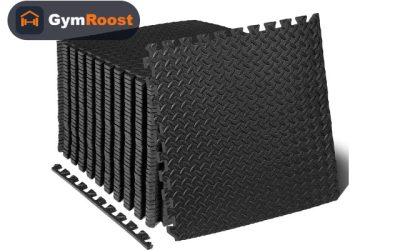
SUPERJARE’s 0.79 inch extra-thick tiles combine a rubber EPDM top with a high-density EVA foam base. Twelve 24 x 24-inch tiles cover 48 sq ft and include detachable edge strips.
They’re far lighter than stall mats, easy to carry and install alone, and quieter thanks to the foam layer. SUPERJARE says the rubber has less odor than typical products.
The foam base can compress under heavy machines and isn’t ideal for frequent heavy drops.
Best for: Easy DIY installation
May not fit: Heavy barbell drops
4. BASELAYER Performance Series TPE Floor Tiles – Best Low-Odor Tiles

- 12 tiles, 19 x 19 x 1/2 in.
- Injection-molded TPE, not foam
- Low odor
- Cord channels underneath
Pros
- ✓ Rubber-like firmness without smell
- ✓ Tight interlocks
- ✓ Good for heavy training
Cons
- ✗ About $250 for 30 sq ft
- ✗ Edges sold separately
- ✗ Few ratings
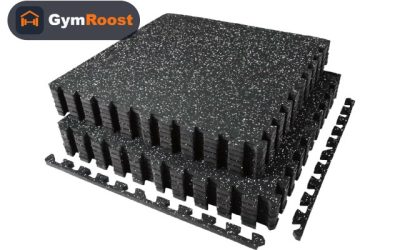
BASELAYER’s Performance Series tiles are injection-molded from TPE, a rubber-like material that’s firm, durable and doesn’t have the smell of recycled rubber. Twelve 19 x 19-inch, 1/2 inch tiles cover 30 sq ft.
Precise interlocks create a flush fit, and channels underneath hide cords, which is useful for treadmills and fans in a garage.
They’re expensive at about $250 per box, and edges and corners are sold separately.
Best for: Low-odor garage gyms
May not fit: Budget buyers
5. IncStores 1/4 in. Tough Rubber Roll – Best Rubber Roll

- 1/4 in. recycled rubber roll
- 3 or 4 ft wide
- Made in the USA
- 5-year warranty
Pros
- ✓ Seamless coverage
- ✓ 5-year warranty
- ✓ Good under machines
Cons
- ✗ Thin for heavy drops
- ✗ Rolls are heavy
- ✗ Can curl at first
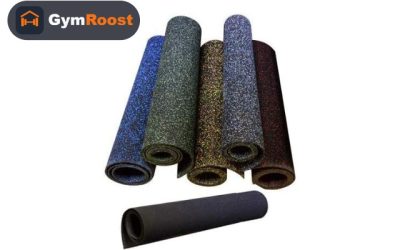
IncStores’ 1/4 inch rubber roll is made in the USA and comes 3 or 4 ft wide, covering large areas with very few seams. It has a 5-year warranty.
It’s well suited to cardio and machine areas and protects floors from moisture and impacts.
At 1/4 inch it’s too thin for heavy barbell drops.
Best for: Cardio zones
May not fit: Heavy lifting areas
6. American Floor Mats 3/8 in. Rubber Roll 4 x 8 ft – Best 3/8 Inch Roll

- 4 x 8 ft x 3/8 in.
- Solid black rubber
- Lays flat
- Good shock absorption
Pros
- ✓ 600+ ratings
- ✓ Seamless 32 sq ft piece
- ✓ Durable
Cons
- ✗ Heavy
- ✗ 3/8 in. thin for big drops
- ✗ About $135
American Floor Mats’ 3/8 inch rubber roll comes in 4 x 8 ft pieces, giving 32 sq ft of seamless coverage with good shock absorption. It has more than 600 ratings at 4.7 stars.
It’s a good middle ground for dumbbell areas and general training.
It’s heavy and not thick enough for big drops.
Best for: General training areas
May not fit: Platform zones
How to Choose Gym Flooring
Pick the right thickness for your training
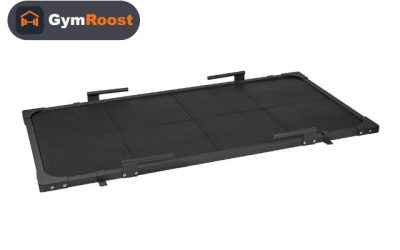
Thickness is the most important decision. 3/16 to 3/8 inch rubber suits cardio machines, bodyweight training and light dumbbells. 1/2 inch flooring handles dumbbells and moderate lifting. 3/4 inch stall mats or tiles are the long-standing standard for barbell training and garage gyms, because they spread the load of a dropped weight and protect concrete. If you regularly drop heavy deadlifts or do Olympic lifts, add 1.5 inch platform tiles or a dedicated lifting platform on top of your base flooring.
Rubber, foam, rubber-top foam or TPE
Solid rubber is the most durable and stable under heavy loads and doesn’t dent under racks or machines. EVA foam puzzle mats are cheap, light and cushioned, but they compress and dent under equipment, so they suit bodyweight and cardio areas. Rubber-top foam tiles add a grippy, durable rubber surface over a foam base, which is a good middle ground. Molded TPE tiles feel similar to rubber without the strong smell, at a higher price.
Stall mats, interlocking tiles or rolls
4 x 6 ft stall mats are the most cost-effective rubber flooring, but each weighs roughly 70 to 115 lb, so moving them takes two people. Interlocking tiles are easy to carry, install and replace, and you can expand later. Rolled rubber covers large areas with very few seams, but rolls are heavy and awkward to handle alone. Choose based on how large your space is and whether you’ll move the flooring later.
Calculate coverage and cost per square foot
Measure your training area and add about 10 percent for cuts and mistakes. A 4 x 6 ft stall mat covers 24 sq ft, while a 12-tile box of 2 x 2 ft tiles covers 48 sq ft. Always compare price per square foot rather than per box or per mat, since product sizes vary widely. In many garages you only need heavy rubber under the rack and lifting area, with cheaper flooring elsewhere.
Plan for the rubber smell
Recycled rubber has a strong odor when new. Air mats outside or in a ventilated garage for several days, then wash them with mild soap and water. Some products, like American Floor Mats’ Ultimate mats and BASELAYER’s TPE tiles, are made to reduce odor, which helps in basements and finished rooms.
Check your subfloor and moisture
Garage and basement concrete can be damp. Rubber tolerates moisture and lets the floor breathe, while foam and carpet may trap it. On wood floors or upstairs rooms, thicker flooring plus drop pads reduces noise and vibration for people below. Make sure the subfloor is level so tiles and mats lie flat.
Install it properly
Cut stall mats with a sharp utility knife and a straightedge, scoring several times rather than forcing one cut. Interlocking tiles snap together without tools. Use edge strips or ramps where flooring meets walkways to avoid tripping, and try to keep heavy equipment legs off tile seams.
Set a sensible budget
Foam puzzle mats can cost under $1 per square foot, rubber-top tiles roughly $2 to $3, rolled rubber $3 to $5 and 3/4 inch stall mats around $5 to $10 depending on brand and shipping. Spend most on the area where weights land and save on the rest.
FAQ
What is the best flooring for a garage gym?
For barbell training, 3/4 inch rubber mats like American Floor Mats’ Ultimate mats or DWC stall mats are the best combination of durability and price. Rubber-top tiles are easier to install, and rolls work well for cardio areas.
How thick should garage gym flooring be?
3/4 inch for lifting areas, 3/8 to 1/2 inch for dumbbells and general training and 1/4 inch for cardio machines. Add platform tiles if you drop heavy deadlifts.
Should I cover the whole garage?
Not necessarily. Many lifters cover only the lifting area with thick rubber and use thinner flooring elsewhere to save money.
Will rubber flooring trap moisture?
Rubber tolerates moisture well, but lift mats occasionally to let damp concrete dry, especially in humid climates.
How do I reduce the rubber smell in my garage?
Choose low-odor products, air mats outside before installing and keep the garage ventilated for the first few weeks.
Can I park on garage gym flooring?
Thick rubber can handle vehicles, but tires and oil can mark it. Many people use rolling storage and keep flooring in the gym area only.
Final Verdict
American Floor Mats’ Ultimate 4 x 7 ft mats are the best garage gym flooring for a clean, low-odor, flat floor. DWC’s stall mats are the best value rubber.
SUPERJARE’s tiles are the easiest to install, BASELAYER’s TPE tiles avoid rubber odor, IncStores’ roll suits cardio zones and American Floor Mats’ 3/8 inch roll is a versatile middle ground.
No reviews yet. Be the first to share your experience!