

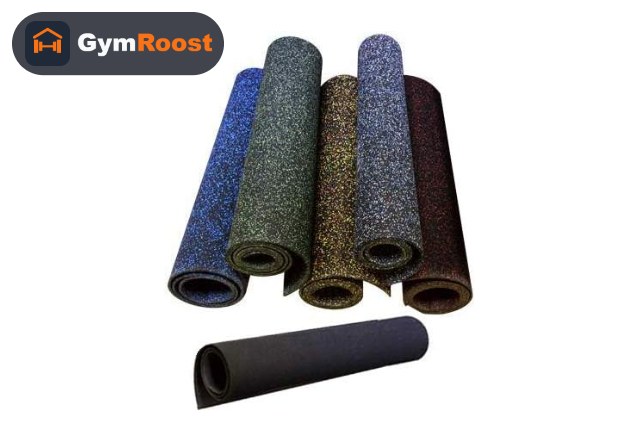
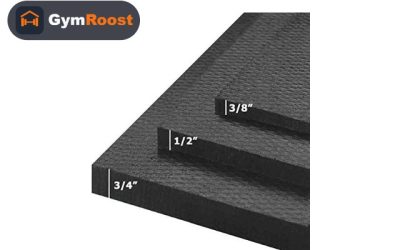
The short answer is that most home gyms need between 3/8 and 3/4 inch of rubber. Bodyweight work, yoga and machines are fine on 1/4 to 3/8 inch, general strength training with controlled weights is comfortable at 3/8 to 1/2 inch, and anyone dropping deadlifts or doing Olympic lifts should use 3/4 inch or more under the landing area.
Thickness is not the only factor. Density, material and what is underneath matter just as much. A dense 3/8 inch rubber roll can outperform a soft 1/2 inch foam tile, and the same flooring behaves differently on concrete than on a wood subfloor. We compared popular Amazon flooring at each thickness, from 3/16 inch rolls to 1 inch tiles, on density, coverage, price and suitability.
Below are our top picks, a comparison table, reviews and a buying guide. For specific rooms, see our guides to flooring for heavy weights, flooring over concrete and thick rubber gym flooring.
Top 3 Flooring Picks by Thickness

American Floor Mats 3/8 in. Rubber Roll 4 x 8 ft
- 4 x 8 ft x 3/8 in.
- Solid black rubber
- Lays flat
- Good shock absorption

American Floor Mats Heavy Duty Stall Mat
- 4 x 6 ft x 3/4 in.
- Solid black rubber
- Wipes or brushes clean
- Lays flat for floors and trailers

ProsourceFit 1/2 in. Puzzle Mat (144 sq ft)
- 36 EVA tiles, 24 x 24 x 1/2 in.
- 144 sq ft with borders
- Non-skid texture
- Phthalate free
Home Gym Flooring Thickness Comparison
| Flooring | Best For | Key Specs | Amazon Rating | Price |
|---|---|---|---|---|
| 1. American Floor Mats 3/8 in. Rubber Roll 4 x 8 ft | Best All-Round 3/8 Inch | 4 x 8 ft x 3/8 in.; Solid black rubber; Lays flat | 4.7/5 | Check Price |
| 2. American Floor Mats Heavy Duty Stall Mat | Best 3/4 Inch | 4 x 6 ft x 3/4 in.; Solid black rubber; Wipes or brushes clean | 4.5/5 | Check Price |
| 3. ProsourceFit 1/2 in. Puzzle Mat (144 sq ft) | Best 1/2 Inch Foam | 36 EVA tiles, 24 x 24 x 1/2 in.; 144 sq ft with borders; Non-skid texture | 4.6/5 | Check Price |
| 4. SUPERJARE 0.4 in. Rubber Top Tiles (96 sq ft) | Best 0.4 Inch Rubber Top | 24 tiles, 24 x 24 in., 0.4 in. thick; EPDM rubber top, EVA foam base; Interlocking edges | 4.5/5 | Check Price |
| 5. AIRHOP 0.56 in. Rubber Top Gym Tiles (48 sq ft) | Best 0.56 Inch Tiles | 12 tiles, 24 x 24 x 0.56 in.; Recycled rubber top, EVA base; Larger interlocking locks | 4.6/5 | Check Price |
| 6. AIRHOP 0.79 in. Rubber Top Gym Tiles (48 sq ft) | Best 0.79 Inch Tiles | 12 tiles, 24 x 24 x 0.79 in.; Rubber top with EVA base; 48 sq ft | 4.7/5 | Check Price |
| 7. Genaflex Pro 1 in. Rubber Gym Tile | Best 1 Inch Tile | 1 in. high-density rubber; Laminated surface; Drop-in installation | 4.5/5 | Check Price |
| 8. BalanceFrom 1 in. Puzzle Exercise Mat | Best 1 Inch Foam Value | 1 in. thick EVA foam; Interlocking tiles; Borders included | 4.6/5 | Check Price |
| 9. Rubber-Cal Elephant Bark 3/16 in. Rubber Roll | Best 3/16 Inch Roll | 3/16 in. recycled rubber; UV and water resistant; 4 ft wide | 4.5/5 | Check Price |
1. American Floor Mats 3/8 in. Rubber Roll 4 x 8 ft – Best All-Round 3/8 Inch
- 4 x 8 ft x 3/8 in.
- Solid black rubber
- Lays flat
- Good shock absorption
Pros
- ✓ 600+ ratings
- ✓ Seamless 32 sq ft piece
- ✓ Durable
Cons
- ✗ Heavy
- ✗ 3/8 in. thin for big drops
- ✗ About $135
American Floor Mats’ 3/8 inch rubber roll is our top pick for most home gyms because it sits right in the sweet spot of thickness for general strength training. The solid rubber covers 32 square feet in a seamless 4 by 8 foot piece, and more than 600 ratings average 4.7 stars.
American Floor Mats’ 3/8 inch rubber roll covers 32 sq ft in one seamless 4 by 8 ft piece. It has more than 600 ratings averaging 4.7 stars.
It lays flat and absorbs shock well.
3/8 inch is thin for big drops.
A single 4 by 8 ft roll covers a full lifting area seamlessly, which looks clean and avoids seam gaps that catch plates.
At 3/8 inch, solid rubber is thick enough to protect a concrete slab from dumbbell drops, absorb the impact of controlled barbell work and quiet racks and benches, without raising the floor level enough to affect doors. It is also dense enough that machine feet do not dent it badly. It is not the choice for dropping heavy deadlifts from lockout, where 3/4 inch is safer, and at about $135 it is not the cheapest option, but it is the best balance of protection, price and ease of installation.
Best for: Most strength training zones
May not fit: Heavy deadlift drops
2. American Floor Mats Heavy Duty Stall Mat – Best 3/4 Inch
- 4 x 6 ft x 3/4 in.
- Solid black rubber
- Wipes or brushes clean
- Lays flat for floors and trailers
Pros
- ✓ Classic garage gym flooring
- ✓ 400+ ratings
- ✓ Very durable
Cons
- ✗ About $230 per mat
- ✗ Very heavy
- ✗ Rubber smell at first
American Floor Mats’ stall mat is 3/4 inch solid rubber, the standard for heavy deadlifts and Olympic lifts.
American Floor Mats’ heavy-duty stall mat is the classic choice for serious home gyms: a solid 4 by 6 ft slab of 3/4 inch black rubber that handles dropped dumbbells, loaded barbells and heavy racks without denting or tearing. It holds a 4.5-star average from more than 430 buyers.
Stall mats like this are made for horse stables, which is why they are so tough. In a gym, three to six mats laid edge to edge create a durable floor that protects concrete, absorbs impact and reduces noise. Liquids and chalk wipe or brush off easily.
Each mat weighs close to 100 lb, so moving them takes two people, and they have a rubber smell for the first few weeks. At about $230 per mat it costs more than farm-store mats, but you get consistent quality delivered to your door.
On paper, you get 4 x 6 ft x 3/4 in., solid black rubber, wipes or brushes clean. Its biggest strengths are classic garage gym flooring and very durable; keep in mind about $230 per mat before ordering.
Best for: Heavy lifting and drops
May not fit: Wall-to-wall coverage
3. ProsourceFit 1/2 in. Puzzle Mat (144 sq ft) – Best 1/2 Inch Foam
- 36 EVA tiles, 24 x 24 x 1/2 in.
- 144 sq ft with borders
- Non-skid texture
- Phthalate free
Pros
- ✓ 61,000+ ratings
- ✓ Covers a whole room
- ✓ Cheap per square foot
Cons
- ✗ Foam dents under heavy weights
- ✗ Not for barbell drops
- ✗ Shows wear
ProsourceFit’s 1/2 inch puzzle mat covers 144 square feet with EVA foam for light, comfortable training.
ProsourceFit’s 1/2 inch puzzle mat covers 144 sq ft with 36 EVA foam tiles and borders. With more than 61,000 ratings, it is the most popular interlocking gym floor on Amazon.
It is cheap per square foot and installs in minutes.
Foam dents under heavy weights and is not for barbell drops.
Thousands of buyers use these tiles for kids’ play areas, yoga rooms and light home gyms. In a lifting space, place heavy equipment on solid rubber mats on top of the foam to prevent dents.
The specifications to note are 144 sq ft with borders, non-skid texture, phthalate free. In daily use the advantages are covers a whole room and cheap per square foot, and the drawbacks are not for barbell drops and shows wear.
Best for: Large rooms and light training
May not fit: Barbell drops or heavy racks
4. SUPERJARE 0.4 in. Rubber Top Tiles (96 sq ft) – Best 0.4 Inch Rubber Top

- 24 tiles, 24 x 24 in., 0.4 in. thick
- EPDM rubber top, EVA foam base
- Interlocking edges
- 96 sq ft
Pros
- ✓ Big coverage for the price
- ✓ Rubber top grips shoes
- ✓ Lightweight
Cons
- ✗ Thin for heavy drops
- ✗ Foam can dent under machines
- ✗ Edge pieces add work
SUPERJARE’s 0.4 inch rubber top tiles cover 96 square feet with a durable rubber surface over EVA foam.
SUPERJARE’s 96 sq ft pack of 0.4 inch rubber-top tiles covers a whole room for about $140. Each 24 by 24 inch tile has an EPDM rubber top over EVA foam, combining rubber grip with foam cushioning.
They are light and quick to install, and the rubber top resists shoe scuffs better than plain foam. They hold a 4.5-star average from about 680 buyers.
At 0.4 inches they are thin for heavy drops, and machines can dent the foam over time.
For a whole-room gym on a budget, 96 square feet of rubber-top tiles transforms a spare room or basement in an afternoon. Use solid rubber mats on top under heavy racks or deadlift areas, and let these tiles cover the rest of the floor.
Key details include 24 tiles, 24 x 24 in., 0.4 in. thick, epdm rubber top, eva foam base, interlocking edges. Buyers most often praise that it is big coverage for the price and rubber top grips shoes, while the main trade-offs to weigh are thin for heavy drops and foam can dent under machines.
Best for: Budget coverage of larger rooms
May not fit: Heavy drops
5. AIRHOP 0.56 in. Rubber Top Gym Tiles (48 sq ft) – Best 0.56 Inch Tiles

- 12 tiles, 24 x 24 x 0.56 in.
- Recycled rubber top, EVA base
- Larger interlocking locks
- 48 sq ft
Pros
- ✓ 1,800+ ratings
- ✓ Quiet and cushioned
- ✓ Easy to install
Cons
- ✗ Not for heavy barbell drops
- ✗ About $120 for 48 sq ft
- ✗ Foam layer compresses
AIRHOP’s 0.56 inch tiles combine a rubber top with an EVA base for quiet, cushioned training.
AIRHOP’s 0.56 inch rubber-top tiles combine a recycled rubber surface with an EVA base and larger interlocking teeth. They are one of the best-reviewed hybrid tiles, with more than 1,800 ratings.
They are quiet and comfortable for dumbbell work, bodyweight training and cardio machines.
They are not built for heavy barbell drops.
They are one of the best options for home gyms that mix dumbbell training, bodyweight work and cardio machines, because the rubber surface resists shoe wear while the foam base stays comfortable for floor exercises.
On paper, you get 12 tiles, 24 x 24 x 0.56 in., recycled rubber top, eva base, larger interlocking locks. Its biggest strengths are 1,800+ ratings and easy to install; keep in mind not for heavy barbell drops before ordering.
Best for: Noise and comfort
May not fit: Dropping heavy weights
6. AIRHOP 0.79 in. Rubber Top Gym Tiles (48 sq ft) – Best 0.79 Inch Tiles
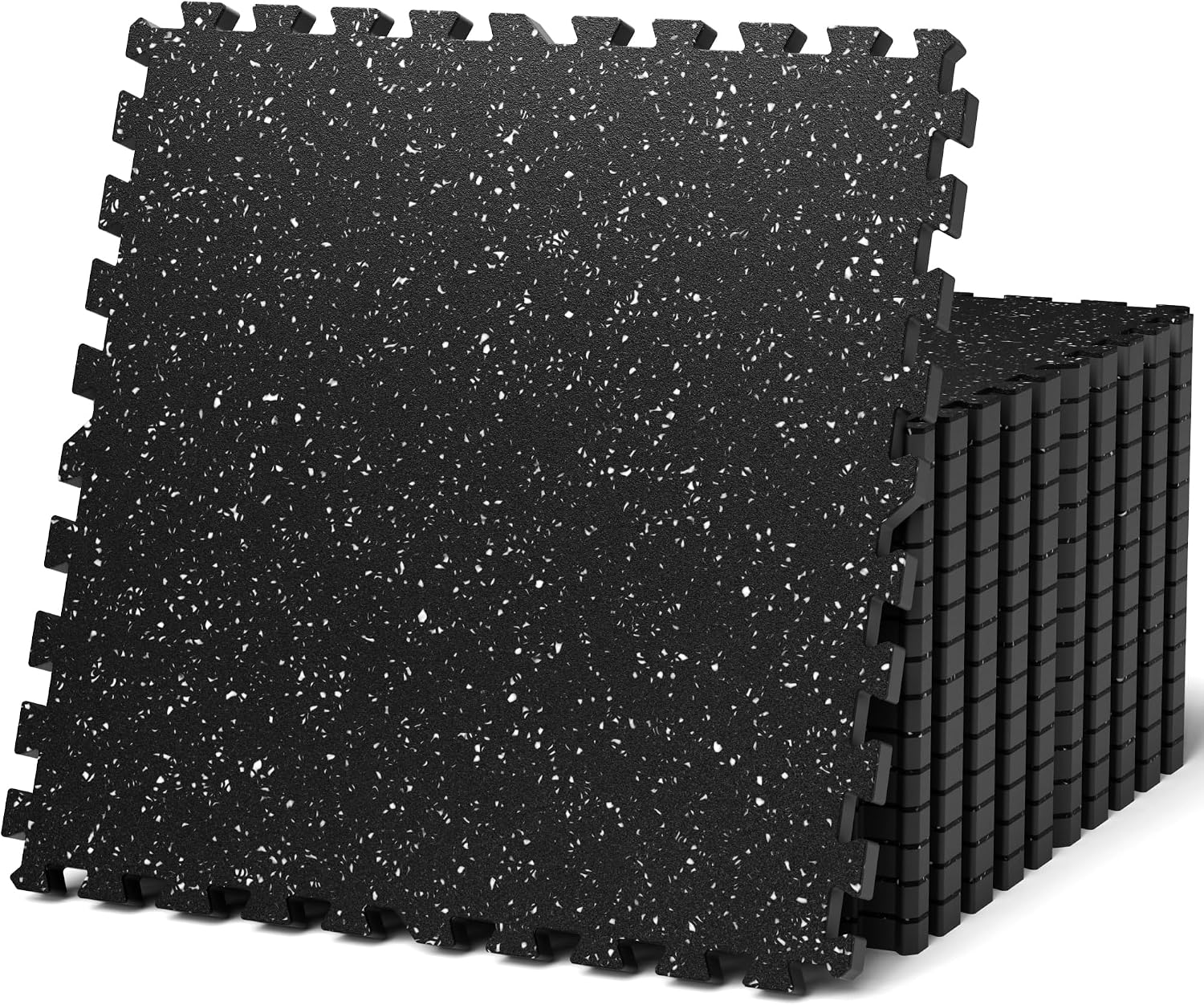
- 12 tiles, 24 x 24 x 0.79 in.
- Rubber top with EVA base
- 48 sq ft
- Interlocking
Pros
- ✓ Thicker cushioning
- ✓ 4.7-star average
- ✓ Good for treadmills and racks
Cons
- ✗ About $140 for 48 sq ft
- ✗ Still foam-based
- ✗ Small coverage per box
AIRHOP’s 0.79 inch tiles add extra cushioning for treadmills, racks and noise control.
AIRHOP’s 0.79 inch tiles add extra cushioning with a rubber top. They hold a 4.7-star average.
Thicker tiles protect floors better under treadmills and racks.
About $140 for 48 sq ft.
The extra thickness also helps on cold concrete, adding insulation and comfort for floor exercises in garages and basements during winter.
The specifications to note are rubber top with eva base, 48 sq ft, interlocking. In daily use the advantages are 4.7-star average and good for treadmills and racks, and the drawbacks are still foam-based and small coverage per box.
Best for: Extra cushioning
May not fit: Heavy barbell drops
7. Genaflex Pro 1 in. Rubber Gym Tile – Best 1 Inch Tile

- 1 in. high-density rubber
- Laminated surface
- Drop-in installation
- 5-year warranty
Pros
- ✓ Thick solid rubber
- ✓ Easy to clean
- ✓ Long warranty
Cons
- ✗ Sold per tile
- ✗ 133 ratings
- ✗ Heavy
Genaflex’s 1 inch tile is high-density rubber with a 5-year warranty, sold per tile.
Genaflex Pro tiles are 1 inch thick high-density, high-impact rubber with a laminated surface that cleans easily, backed by a 5-year warranty.
Maximum shock absorption for lifting zones.
Priced per tile.
Key details include 1 in. high-density rubber, laminated surface, drop-in installation. Buyers most often praise that it is thick solid rubber and easy to clean, while the main trade-offs to weigh are sold per tile and 133 ratings.
Best for: Maximum impact protection
May not fit: Budget coverage
8. BalanceFrom 1 in. Puzzle Exercise Mat – Best 1 Inch Foam Value

- 1 in. thick EVA foam
- Interlocking tiles
- Borders included
- 2-year warranty
Pros
- ✓ 60,000+ ratings
- ✓ Very cushioned
- ✓ Good for floor workouts
Cons
- ✗ Too soft for heavy equipment
- ✗ Foam dents
- ✗ Not for lifting drops
BalanceFrom’s 1 inch puzzle mat adds a thick foam layer for exercise and mobility work.
BalanceFrom’s 1 inch puzzle mat is extra cushioned EVA foam with borders and a 2-year warranty. It has more than 60,000 ratings.
It is excellent for floor workouts, stretching and bodyweight training.
Too soft for heavy equipment.
They are best for stretching, yoga, kids and bodyweight circuits rather than equipment areas, where 1 inch foam feels unstable.
On paper, you get 1 in. thick eva foam, interlocking tiles, borders included. Its biggest strengths are 60,000+ ratings and good for floor workouts; keep in mind too soft for heavy equipment before ordering.
Best for: Stretching and floor work
May not fit: Barbell training
9. Rubber-Cal Elephant Bark 3/16 in. Rubber Roll – Best 3/16 Inch Roll

- 3/16 in. recycled rubber
- UV and water resistant
- 4 ft wide
- No adhesive
Pros
- ✓ 1,300+ ratings
- ✓ Lightweight
- ✓ Indoor or outdoor
Cons
- ✗ Thin
- ✗ Odor at first
- ✗ Not for heavy drops
Rubber-Cal’s 3/16 inch roll is a lightweight, durable surface for light training and covering large areas cheaply.
Rubber-Cal’s Elephant Bark rolled flooring is a thin 3/16 inch recycled rubber roll with UV and water resistance, made for exercise areas and installed without adhesive, with more than 1,300 ratings.
Proven and easy to install.
Too thin for heavy drops.
The specifications to note are uv and water resistant, 4 ft wide, no adhesive. In daily use the advantages are lightweight and indoor or outdoor, and the drawbacks are odor at first and not for heavy drops.
Best for: Light training and large rooms
May not fit: Heavy drops
How to Choose the Right Thickness for Home Gym Flooring
Match thickness to your heaviest movement
For bodyweight, yoga and machines, about 1/4 to 3/8 inch is enough. For general strength training with dumbbells and barbells that you lower rather than drop, 3/8 to 1/2 inch works. If you drop deadlifts or do Olympic lifts, step up to 3/4 inch or more under the landing area. Choose the thickness for the hardest thing you do, not the average session.
Understand your subfloor
Concrete is hard and unforgiving, so thicker rubber protects both the slab and your joints. Wood subfloors flex and transmit noise to rooms below, so density and thickness both help. If your gym is on a second floor, favor thicker, denser rubber to reduce vibration, and consider adding a plywood layer underneath the lifting area.
Prefer density over raw thickness
A dense 3/8 inch vulcanized rubber roll can outperform a soft 1/2 inch foam tile. Solid rubber resists dents from racks and dropped plates, while foam compresses and rebounds more slowly. Check the material: solid or recycled rubber is the heavy-duty choice, rubber over foam is a comfort compromise, and pure EVA foam is best for light use only.
Account for equipment feet and racks
Heavy racks, benches and machines press their feet into any flooring, and thin or soft surfaces show permanent dents. Thicker rubber of 3/4 inch spreads the load and recovers better. For machines with small feet, use support pads or a plywood footprint under the equipment to avoid indentation.
Check clearance and transitions
Thicker flooring creates a raised edge at doorways and can interfere with garage doors, treadmills or cabinets. Plan transitions with ramps or beveled edges, and measure door clearance before buying 3/4 inch mats for a space that opens onto a hallway or garage door track.
Balance thickness with cost
Price rises quickly with thickness, so cover only the zones that need it. Many lifters put 3/4 inch mats under the rack and platform and use thinner flooring elsewhere. That approach protects the areas that take impact and keeps the total bill manageable.
FAQ
How thick should home gym flooring be?
For most home gyms, 3/8 to 3/4 inch of rubber is right. Use 3/8 inch for general strength training, 1/2 inch for extra comfort and 3/4 inch under deadlift and Olympic lifting areas.
Is 3/8 inch rubber enough for a home gym?
Yes for dumbbells, controlled barbell work, machines and cardio. It is not ideal for repeated heavy deadlift drops, where 3/4 inch is safer.
Is 1/4 inch gym flooring enough?
It works for bodyweight training, yoga and light machines, but it offers little protection against dropped weights.
Is thicker flooring always better?
Not always. Density and material matter too, and thick foam can feel unstable under heavy lifts. Very thick flooring can also create tripping edges at doorways.
How thick for deadlifts?
Use 3/4 inch of solid rubber or more under the landing area, ideally with drop pads or a platform for heavy pulls.
Does thickness matter on concrete?
Yes. Concrete is hard, so thicker rubber protects the slab, plates and joints, and reduces noise.
Final Verdict
For most home gyms, 3/8 inch solid rubber is the best balance of protection and price, and American Floor Mats’ 3/8 inch roll is our top pick. Step up to 3/4 inch stall mats under racks and deadlift areas, and use thinner foam or rubber-top tiles only for light training.
Mixing thicknesses is a smart way to save money: put 3/4 inch mats where you drop weights and thinner flooring elsewhere. For more help planning, see our guide to calculating home gym flooring.
No reviews yet. Be the first to share your experience!